
Wormhole Travel Planner
Explore theoretical shortcuts through spacetime—the ultimate cosmic subway system
Tunneling Through the Fabric of Space
Einstein’s general relativity allows for extraordinary possibilities: spacetime could fold in on itself, creating shortcuts between distant points. These theoretical passages—called wormholes or Einstein-Rosen bridges—could connect different locations across the universe, or even different times. The catch? We don’t know if traversable wormholes can exist, and if they do, they would require exotic matter with negative energy density.
Our Wormhole Travel Planner explores the physics of these hypothetical shortcuts. Calculate travel times through wormholes versus conventional space travel, understand the exotic matter requirements, and discover why wormholes might double as time machines. This is speculative physics at its most mind-bending.
From Einstein to Interstellar
Wormholes emerged from Karl Schwarzschild’s 1916 solution to Einstein’s equations. The Einstein Online resource explains their mathematical foundation. The film “Interstellar” famously visualized traversable wormholes, with physicist Kip Thorne as science advisor. Compare wormhole travel to conventional journeys with our Interstellar Travel Calculator.
Wormhole Travel Planner
Plan journeys through theoretical spacetime shortcuts:
🌀 Wormhole Travel Planner
Plan theoretical faster-than-light travel through spacetime shortcuts!
🔬 The Science of Wormholes
🚀 Plan Your Route
Compare wormhole transit times to conventional travel, calculate exotic matter requirements, and explore the physics of spacetime tunnels.
The Physics of Wormholes
What Is a Wormhole?
Imagine folding a piece of paper so two distant points touch, then poking a hole through. The hole represents a wormhole—a shortcut through the higher-dimensional “bulk” rather than traversing the paper’s surface. In spacetime, a wormhole would connect two regions through a tunnel shorter than the external path.
Mathematically, wormholes are solutions to Einstein’s field equations where spacetime has non-trivial topology—two mouths connected by a throat. The original Morris-Thorne paper established requirements for traversable wormholes in 1988.
Types of Wormholes
- Schwarzschild wormholes: The simplest mathematical wormhole, connecting two black holes. Not traversable—it pinches off faster than anything can pass through
- Traversable wormholes: Hypothetical wormholes held open long enough for passage. Require exotic matter
- Quantum wormholes: Microscopic wormholes might exist at quantum scales (Planck length). Explore these scales with our Planck to Cosmic Time Calculator
- Wormholes in string theory: Some string theory models suggest wormholes could connect distant parts of the universe through extra dimensions
The Exotic Matter Problem
Traversable wormholes require exotic matter—material with negative energy density that violates the weak energy condition. This isn’t science fiction; certain quantum effects produce small amounts of negative energy:
- Casimir effect: Between two parallel plates, vacuum energy is negative compared to outside—a real, measured phenomenon
- Squeezed vacuum states: Quantum optics produces states with negative energy density in limited regions
- Hawking radiation: Involves negative energy flux into black holes. Our Hawking Radiation Timer explores this phenomenon
However, known exotic matter exists only in microscopic amounts for brief periods. A traversable wormhole large enough for a human would require quantities far beyond anything we can produce—perhaps Jupiter masses of exotic matter.
The arXiv physics archive contains ongoing research into wormhole traversability conditions and the quantum inequalities that might limit exotic matter concentrations.
Wormholes as Time Machines
Perhaps the most mind-bending aspect: traversable wormholes could potentially function as time machines. Kip Thorne demonstrated that if you could move one wormhole mouth at high speed relative to the other (or place one near a massive object), time dilation would cause the two mouths to exist at different times.
Enter through one mouth, exit the other into your own past. Our Time Dilation Calculator explores the relativistic effects that make this theoretically possible.
Chronology Protection
Stephen Hawking proposed the “chronology protection conjecture”—that the laws of physics prevent time travel to avoid paradoxes. Quantum effects might destabilize any wormhole attempting to form a time machine, destroying it before it could be used. This remains unproven but suggests nature might prohibit causality violations.
Practical Considerations (Highly Speculative)
If traversable wormholes were possible, what would using one be like?
Travel time: Depending on wormhole geometry, passage could be nearly instantaneous or take hours/days. Either way, far faster than the years or millennia required for conventional interstellar travel.
Tidal forces: A sufficiently large wormhole would have manageable tidal forces. A small wormhole would spaghettify travelers, similar to black holes. Our Black Hole Survival Timer explores these extreme effects.
Navigation: You’d need to know exactly where the other mouth opens. A wormhole to a random location in intergalactic void wouldn’t be very useful.
Stability: Natural wormholes (if they exist) would likely be unstable. Engineering stable wormholes would require precise control of exotic matter distribution—technology far beyond current understanding.
Frequently Asked Questions
Do wormholes actually exist?
We don’t know. They’re valid mathematical solutions to Einstein’s equations, but we’ve never observed one. Microscopic quantum wormholes might exist and pop in and out of existence constantly at the Planck scale. Macroscopic traversable wormholes are purely hypothetical—allowed by physics but perhaps not realized in nature.
What would a wormhole look like?
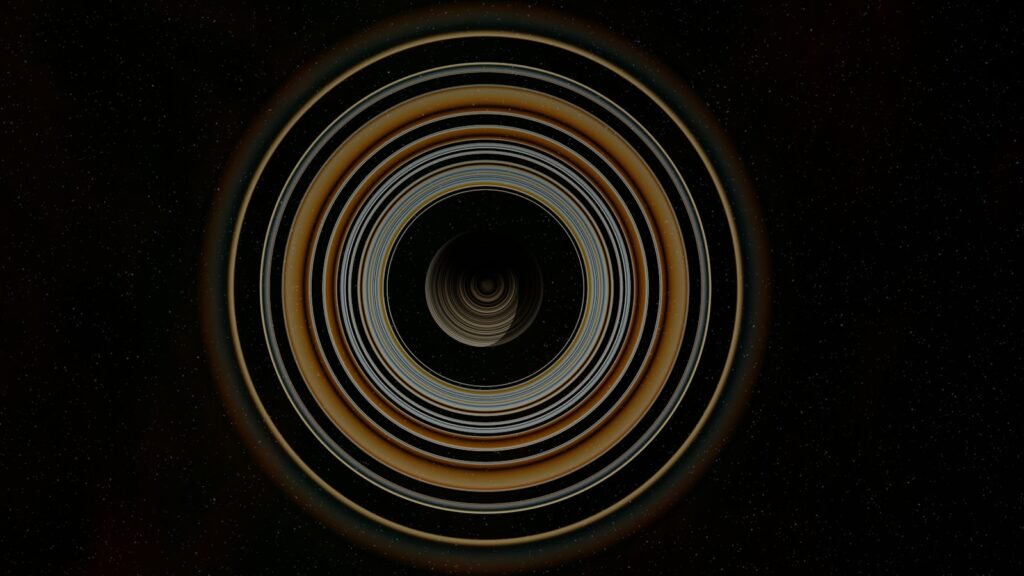
A wormhole mouth would appear as a spherical region of distorted space. Light from the destination would be visible through it, like looking through a window to another part of the universe. The “Interstellar” film worked with Kip Thorne to visualize this accurately—though in reality, a wormhole would likely show extreme gravitational lensing.
Could we create a wormhole?
Not with any technology we can imagine. We don’t know how to produce the exotic matter required, manipulate spacetime geometry, or even detect if a wormhole exists. If possible at all, it would require a civilization far more advanced than ours—perhaps Type II or III on the Kardashev scale. Explore advanced civilizations with our Dyson Sphere Calculator.
Are wormholes and black holes related?
Mathematically, yes. A Schwarzschild wormhole connects two black hole singularities through a “bridge.” However, this type of wormhole is non-traversable. Some theorists speculate that rotating (Kerr) black holes might have traversable internal structures, but this remains highly speculative and would likely require exotic matter anyway.
Explore More Spacetime Physics
Wormholes represent the frontier of theoretical physics. Continue exploring:
- Gravitational Wave Detector – Listen to spacetime ripples
- Cosmic Distance Ladder – Measuring the universe without shortcuts
- Speed of Darkness Calculator – Explore limits of causality
- Quantum Probability Visualizer – The quantum effects underlying exotic matter
- Time to Universe Edge Calculator – How far is “far” without wormholes?
Wormholes embody physics’ most tantalizing possibility: that the vast distances separating us from distant stars might be circumvented entirely. Whether these cosmic shortcuts exist remains unknown, but exploring them teaches us profound truths about the nature of space, time, and possibility.