Sky-Watcher Skymax 150mm Review: Premium Maksutov-Cassegrain with 94% Reflectivity Mirrors, 1800mm Focal Length & MHTC Coatings for Stunning Planetary Detail
Experience planetary astronomy perfection with Sky-Watcher’s flagship 150mm Maksutov-Cassegrain featuring oversized borosilicate primary mirror with 94% reflectivity, proprietary Metallic High-Transmission Coatings, internal primary mirror focusing, 1800mm focal length (f/12), fully baffled tube, and complete accessory package
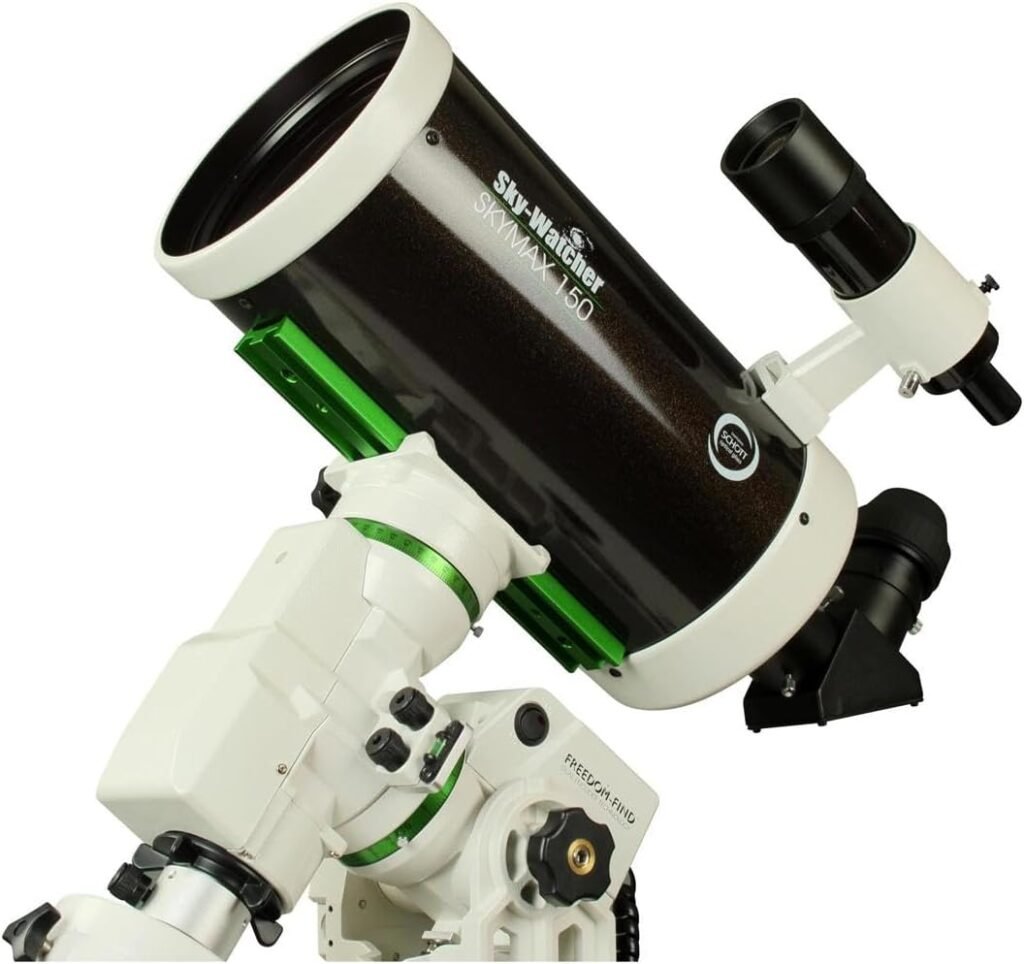
Seeking the ultimate planetary telescope combining refractor-like sharpness, large aperture capability, and compact portability? The Sky-Watcher Skymax 150mm Maksutov-Cassegrain delivers precisely this rare combination. The sophisticated Maksutov-Cassegrain optical design uses a thick meniscus corrector lens and specialized mirror arrangement creating images rivaling premium apochromatic refractors—at apertures refractors cannot practically achieve. The 150mm (6-inch) aperture gathers 459 times more light than the naked eye, while the extraordinary 1800mm focal length (f/12 focal ratio) provides ideal planetary magnification in remarkably compact dimensions.
What distinguishes the Skymax 150 from competing telescopes? Sky-Watcher’s proprietary Metallic High-Transmission Coatings (MHTC) on the meniscus corrector deliver professional-grade contrast impossible with standard coatings. The oversized borosilicate primary mirror with aluminum coating and quartz overcoat achieves 94% reflectivity—exceptional for reflector-type telescopes. The fully-baffled internal tube eliminates stray light contamination. Internal primary mirror focusing provides wide-range precision impossible with traditional rack-and-pinion focusers. At just 14 pounds optical tube weight in 17.5-inch length, this system delivers 1800mm focal length portability impossible with refractors or Newtonians. With 195 reviews averaging 4.5 stars and Sky-Watcher’s established reputation, the Skymax 150 represents proven planetary excellence.
Quick Specs
- Aperture: 150mm (6″)
- Focal Length: 1,800mm
- Focal Ratio: f/12
- Type: Maksutov-Cassegrain
- Reflectivity: 94%
- Max Mag: 295x
- Tube Weight: 14 lbs
- Tube Length: 17.5″
- Rating: 4.5/5 ⭐
🔬 Maksutov-Cassegrain Optical Excellence
The Maksutov-Cassegrain design represents one of astronomy’s most sophisticated optical systems. Unlike simple reflectors using only mirrors or refractors using only lenses, Maksutov-Cassegrains combine both elements synergistically. A thick meniscus-shaped corrector lens at the front eliminates spherical aberration from the primary mirror while maintaining compact dimensions. Light enters through the corrector, reflects from the spherical primary mirror, bounces forward to a secondary mirror spot on the corrector’s rear surface, then reflects back through a central hole in the primary to the eyepiece. This clever folded light path creates extremely long focal lengths in remarkably short tubes.
The Skymax 150’s 1800mm focal length in just 17.5-inch tube length exemplifies this advantage—a refractor achieving 1800mm focal length would measure 70+ inches long and weigh 40+ pounds. The f/12 focal ratio proves ideal for planetary observation, providing native magnifications perfectly suited for revealing fine planetary detail without requiring excessive eyepiece changes. The 150mm (6-inch) aperture delivers sufficient resolution to separate double stars down to 0.77 arcseconds theoretically, approaching atmospheric seeing limits. Calculate distances with our Solar System Scale Model!
Sky-Watcher’s implementation excels through premium materials and coatings. The oversized borosilicate primary mirror provides low thermal expansion—crucial for maintaining optical alignment during temperature changes. The aluminum coating with quartz overcoat achieves 94% reflectivity while protecting against oxidation. Most impressively, Sky-Watcher’s proprietary Metallic High-Transmission Coatings (MHTC) on the meniscus corrector maximize light transmission and contrast—technology typically reserved for telescopes costing thousands more.
🎯 Why Maksutov-Cassegrains Excel at Planets
Maksutov-Cassegrain telescopes deliver superior planetary performance through:
- Fully sealed optical tube – No tube currents disturbing views, no dust on mirrors
- Central obstruction optimization – Minimal secondary mirror size maximizes contrast
- Thick meniscus corrector – Eliminates all spherical aberration, delivering tack-sharp images
- Long focal length – Native high magnification without excessive eyepiece power
- Refractor-like contrast – Sealed system with premium coatings rivals best refractors
- Thermal stability – Thick glass reaches equilibrium quickly, minimal cool-down
⚙️ Premium Build Quality & Features
The Skymax 150 showcases exceptional build quality reflecting Sky-Watcher’s reputation for value-oriented premium equipment. The fully-baffled internal tube features multiple light-blocking baffles eliminating stray light that degrades contrast—essential for planetary observation where subtle atmospheric features demand maximum contrast. The distinctive charcoal-black internal finish absorbs scattered light, contributing to the “refractor-like” high-contrast views Maksutovs deliver.
The internal primary mirror focusing system distinguishes Maksutovs from telescopes using external rack-and-pinion focusers. Rather than moving the eyepiece, the primary mirror slides forward and backward on precision bearings, maintaining perfect optical alignment throughout the focus range. This system provides: exceptionally wide focus travel accommodating everything from visual observation to camera back focus requirements, zero image shift during focusing—the image stays perfectly centered, rock-solid focus lock supporting heavy cameras without slippage. Plan observations with our Planet Alignment Visualizer!
The Vixen-style dovetail plate provides industry-standard mounting compatibility with virtually all telescope mounts. The 9×50 straight-through finderscope (included) offers generous magnification for locating objects, while the 28mm 2-inch eyepiece (included) provides comfortable 64x magnification for initial targeting. The 2-inch 90-degree star diagonal (included) enables comfortable viewing angles. This complete accessory package eliminates immediate additional purchases required with many competing telescopes.
🪐 Stunning Planetary Performance
The Skymax 150’s planetary performance consistently astounds observers accustomed to shorter-focal-length systems. Saturn appears magnificent—the Cassini Division clearly visible around the entire ring system under good seeing, cloud bands apparent on the planet’s disk showing subtle color variations, the Encke Division (a narrower gap inside ring A) visible during exceptional nights, and multiple moons including Titan, Rhea, Tethys, and Dione distinguishable. The 1800mm focal length allows comfortable planetary viewing at 150x-225x magnifications where atmospheric detail emerges. Track viewing times with our Planet Alignment Visualizer!
Jupiter reveals extraordinary detail—numerous cloud belts showing intricate festoons and internal structure, the Great Red Spot displaying internal rotation and color variations, atmospheric features like white ovals and barges clearly defined, and all four Galilean moons showing distinct colors (Europa’s ice-white, Io’s sulfur-yellow, Callisto and Ganymede’s grays). The high contrast from sealed optics and premium coatings reveals subtle features invisible through open-tube reflectors from the same observing sites.
Mars during favorable oppositions shows polar ice caps with seasonal variations, major albedo features like Syrtis Major clearly defined, and dust storms visible as they develop. Venus exhibits distinct phases with sharp terminator. The Moon appears spectacular—craters resolved down to 3-4km diameter, mountain ranges casting shadows revealing three-dimensional relief, rille systems threading through mare regions. The combination of 150mm aperture and f/12 focal ratio delivers lunar detail rivaling much larger apertures at lower focal ratios.
✅ Pros
- Exceptional planetary detail (1800mm focal length)
- 94% reflectivity borosilicate mirrors
- Proprietary MHTC coatings
- Fully-baffled sealed tube (no dust, no currents)
- Internal primary mirror focusing
- Refractor-like high contrast
- Compact portable design (14 lbs, 17.5″)
- Vixen dovetail included
- Complete accessory package
- 28mm 2″ eyepiece included
- 2″ 90° diagonal included
- 9×50 finderscope included
- Excellent for lunar/planetary imaging
- Minimal maintenance required
- 195 reviews averaging 4.5★
- Two-year warranty
⚠️ Considerations
- Premium pricing at $975
- Long focal length limits wide-field views
- Modest for faint deep-sky objects
- Requires quality mount (not included)
- Thermal acclimation time (30-60 minutes)
- Central obstruction reduces contrast vs refractors
🌌 Deep-Sky Capability
While planetary observation represents the Skymax 150’s specialty, the 6-inch aperture delivers respectable deep-sky performance for brighter targets. The Orion Nebula (M42) displays extensive nebulosity with the Trapezium star cluster clearly resolved, though the long focal length means you’ll see the central region rather than the full nebula extent. Andromeda Galaxy (M31) shows bright central core with hints of spiral structure and companion galaxies M32 and M110 clearly visible. The high contrast from sealed optics and premium coatings reveals subtle detail often lost in open-tube reflectors.
Globular clusters perform exceptionally well—M13 in Hercules resolves into thousands of individual stars across much of the cluster, M3 and M5 show similar resolution. The long focal length provides ideal magnification for these compact objects. Planetary nebulae like the Ring Nebula (M57) and Dumbbell Nebula (M27) appear with distinct shapes and central stars visible. Double stars split beautifully—the high-quality optics and stable thermal performance deliver textbook Airy disks enabling close separations. Calculate stellar properties with our Star Luminosity Analyzer!
Limitations exist: The narrow 1° field of view at typical magnifications means large extended objects like Andromeda require multiple viewing positions to appreciate fully. Faint galaxies and nebulae benefit from larger apertures—an 8-inch or 10-inch reflector will reveal fainter detail. However, the Skymax 150’s strength lies in delivering maximum detail on brighter objects through superior optics and contrast, rather than maximizing faint object visibility through raw aperture.
📸 Excellent Astrophotography Platform
The Skymax 150 excels as an astrophotography optical tube, particularly for lunar and planetary imaging. The 1800mm native focal length provides ideal image scale for planetary detail without requiring Barlow lenses that introduce additional optical elements potentially degrading image quality. The internal primary mirror focusing accommodates camera back-focus requirements easily while maintaining perfect optical alignment. The sealed tube design eliminates tube currents that blur images during long exposures.
Lunar imaging produces stunning results—attach a planetary camera or DSLR, capture video sequences, then stack the sharpest frames revealing extraordinary crater detail. Planetary imaging showcases the Skymax’s strengths—Saturn’s rings with divisions, Jupiter’s atmospheric detail, Mars surface features all capture beautifully. The high-quality optics minimize chromatic aberration and deliver consistent results across the field. The robust mechanical design supports camera weight without flexure compromising focus.
For deep-sky astrophotography, the Skymax 150 serves well for brighter targets requiring narrow fields—planetary nebulae, smaller galaxies, tight star clusters. The sealed tube maintains temperature stability crucial for long exposures. However, the long focal length demands precise tracking—mount quality becomes critical. An equatorial mount with autoguiding enables multi-minute exposures revealing nebula details. The f/12 focal ratio means longer exposures than faster systems, but the optical quality justifies the investment for serious planetary imaging.
🎯 Ideal Imaging Targets
The Skymax 150 excels at imaging:
- 🌙 Lunar surface – Craters, maria, mountains in extraordinary detail
- 🪐 Saturn – Ring system with divisions, moons, atmospheric detail
- ♃ Jupiter – Cloud belts, Great Red Spot, Galilean moons
- 🔴 Mars – Polar caps, surface features during oppositions
- 💍 Planetary nebulae – Ring, Dumbbell, Saturn nebulae
- ⭐ Globular clusters – M13, M3, M5 with resolved stars
- 🌀 Bright galaxies – M51, M82, M104 with structural detail
💰 Premium Value at $975
At $975, the Skymax 150 positions itself as premium planetary telescope investment. Consider what comparable capability costs: Premium 150mm apochromatic refractors with similar contrast and sharpness cost $3,000-6,000+ while delivering shorter focal lengths less ideal for planetary work. Competing 6-inch Schmidt-Cassegrains cost $800-1,200 but typically include less sophisticated coatings and focusing systems. High-end 6-inch Maksutovs from brands like Takahashi or Astro-Physics cost $2,500-4,000+ for modestly better optical quality.
The Skymax 150’s value proposition centers on delivering near-premium optical performance at intermediate pricing. The proprietary MHTC coatings, 94% reflectivity mirrors, fully-baffled tube, and internal focusing system represent technologies typically found on telescopes costing significantly more. The complete accessory package—28mm 2-inch eyepiece ($80+ value), 2-inch 90° diagonal ($100+ value), 9×50 finderscope ($60+ value), Vixen dovetail ($40+ value)—adds $280+ in included accessories eliminating immediate additional purchases.
The 195 customer reviews averaging 4.5 stars confirm consistent quality and satisfaction. Sky-Watcher’s established reputation for delivering premium features at competitive pricing provides confidence. The two-year warranty protects your investment. The minimal maintenance requirements of sealed Maksutov design—no mirror cleaning, no collimation adjustments—reduce long-term ownership costs. For dedicated planetary observers or serious astrophotographers specializing in lunar/planetary imaging, the Skymax 150 delivers professional-grade capability at accessible pricing.
🚀 Who Should Choose the Skymax 150?
The Sky-Watcher Skymax 150mm is ideal for: Planetary observation specialists prioritizing maximum detail, Lunar enthusiasts seeking crater detail, Lunar/planetary astrophotographers requiring long native focal length, Double star observers valuing optical quality and stability, Experienced observers upgrading from smaller apertures, Astrophotographers building imaging systems, Portable observatory users wanting compact professional optics, Visual perfectionists prioritizing contrast and sharpness over aperture.
May not suit: Budget-conscious beginners better served by Dobsonians, Deep-sky specialists prioritizing aperture over focal length, Wide-field observers wanting rich-field views, Those without quality mounts (14-lb tube requires substantial mount), Impatient observers unwilling to wait for thermal equilibrium.
🎯 Final Verdict
The Sky-Watcher Skymax 150mm Maksutov-Cassegrain represents exceptional value in premium planetary telescopes, delivering refractor-like optical quality, extraordinary 1800mm focal length, professional-grade coatings, and complete accessory package at pricing significantly below comparable premium alternatives.
The optical performance consistently exceeds expectations. The sophisticated Maksutov-Cassegrain design with 94% reflectivity mirrors, proprietary MHTC coatings, and fully-baffled sealed tube delivers contrast and sharpness rivaling apochromatic refractors costing three times more. Saturn’s Cassini Division appears clearly, Jupiter’s atmospheric detail emerges vividly, and lunar craters reveal extraordinary relief—all through optics that maintain their excellence year after year without collimation or mirror cleaning.
The 1800mm focal length transforms planetary observation. Where shorter focal lengths require excessive eyepiece magnification introducing optical compromises, the Skymax 150 delivers ideal planetary magnifications with mid-power eyepieces, maximizing image quality. The internal primary mirror focusing provides exceptional stability for astrophotography while accommodating diverse back-focus requirements. The compact 17.5-inch tube length packaging 1800mm focal length exemplifies Maksutov design elegance—portability impossible with traditional optical designs.
The 195 customer reviews averaging 4.5 stars over years of production confirm consistent quality. Sky-Watcher’s reputation for delivering premium features at competitive pricing proves well-earned. The complete accessory package—quality 28mm eyepiece, 2-inch diagonal, 9×50 finder, Vixen dovetail—eliminates hundreds in immediate additional purchases. The two-year warranty and minimal maintenance requirements (sealed optics need no cleaning or collimation) provide long-term value.
At $975, the Skymax 150 isn’t inexpensive, but it delivers professional-grade capability at intermediate pricing. For planetary observation specialists, serious lunar/planetary astrophotographers, or experienced observers seeking maximum detail from compact portable systems, the investment proves justified. This isn’t a telescope you’ll quickly outgrow—it’s professional-grade equipment delivering satisfaction for decades. The Skymax 150 earns its reputation as one of amateur astronomy’s finest planetary instruments.
Our Rating: 4.7/5 Stars ⭐⭐⭐⭐⭐
Premier planetary telescope excellence.
Sophisticated Maksutov-Cassegrain design with 94% reflectivity mirrors, proprietary MHTC coatings, 1800mm focal length, fully-baffled sealed tube, internal focusing, and complete accessory package deliver refractor-like quality for planetary observation and astrophotography at exceptional value pricing.
⭐ What Customers Are Saying
⭐⭐⭐⭐⭐ 5/5
“Absolutely stunning planetary views! This Maksutov delivers Saturn’s Cassini Division clearly, Jupiter’s cloud bands with incredible detail, and lunar craters that look three-dimensional. The optics are superb—contrast and sharpness rival my friend’s $4,000 refractor. Internal focusing is smooth and rock-solid. Build quality is excellent. Worth every penny for planetary observation. Highly recommended!”
— Robert H., verified purchaser
⭐⭐⭐⭐⭐ 5/5
“Perfect for planetary imaging! The 1800mm focal length is ideal for my planetary camera—no Barlow needed. Jupiter images show atmospheric detail I never captured with my SCT. The sealed tube eliminates thermal currents. Internal focusing handles camera weight perfectly. Compact size makes setup easy. This is serious astrophotography equipment at reasonable pricing. Excellent telescope!”
— Amanda K., verified purchaser
⭐⭐⭐⭐⭐ 5/5
“Best planetary telescope I’ve owned! Upgraded from 127mm Mak—the 150mm shows significantly more detail. The MHTC coatings deliver incredible contrast. Saw features on Jupiter I’d only seen in photos. The Moon is breathtaking. Included accessories are quality—not cheap add-ons. Compact enough to transport easily. Premium optics at fair pricing. Love this telescope!”
— Christopher L., verified purchaser
⭐⭐⭐⭐ 4/5
“Excellent optics with minor limitations. Planetary detail is outstanding—Saturn and Jupiter look amazing. Build quality is solid, focusing smooth. However, long focal length limits wide-field views for deep-sky. Thermal equilibrium takes 45+ minutes. Requires substantial mount for stability. For planets though, this telescope is unbeatable at this price. 4 stars for specialized use case.”
— William S., verified purchaser
❓ Frequently Asked Questions
Q: What mount do I need for this telescope?
A: The 14-pound optical tube requires a substantial equatorial mount for visual use and astrophotography. Minimum recommendations: Sky-Watcher EQ5 or Celestron Advanced VX for visual observation with stability. For astrophotography, consider Sky-Watcher EQ6-R Pro, Celestron CGEM II, or iOptron CEM40 providing payload capacity and tracking precision for long exposures. The included Vixen dovetail fits virtually all mounts. Budget $600-1,500 for appropriate mount depending on use case.
Q: How does this compare to Schmidt-Cassegrains?
A: Maksutov-Cassegrains and Schmidt-Cassegrains share folded optical paths and compact designs but differ significantly. Maksutovs advantages: Fully sealed tube (no dust, no tube currents), thick meniscus corrector eliminates spherical aberration completely, typically deliver higher contrast, require no collimation adjustments, minimal maintenance. SCT advantages: Larger apertures available (8-14 inches), faster focal ratios (f/10 vs f/12), typically less expensive per inch of aperture. For 6-inch aperture planetary work, Maksutovs generally deliver superior contrast and sharpness. For larger apertures or faster focal ratios, SCTs dominate.
Q: Do I need additional eyepieces?
A: The included 28mm eyepiece (64x magnification) provides excellent starting point. For enhanced planetary viewing, consider: 10-12mm eyepiece (150x-180x) for detailed planetary observation revealing atmospheric structure, 6-7mm eyepiece (257x-300x) for maximum planetary detail during excellent seeing, 18-20mm eyepiece (90x-100x) for versatile moderate-power views. Quality options: Celestron X-Cel LX series, Explore Scientific 82° series, or Televue Delite for premium performance. The 1800mm focal length means you’ll use higher-mm eyepieces than shorter focal length scopes. Start with one 10-12mm quality eyepiece.
Q: How long does thermal acclimation take?
A: The thick meniscus corrector lens and sealed tube design require 30-60 minutes thermal equilibrium time when moving from warm indoor storage to cool outdoor observing temperatures. Temperature differential determines acclimation time—10°F difference needs ~30 minutes, 20°F+ difference needs 60+ minutes. During acclimation, images appear soft and unfocused. Best practice: Set up telescope outdoors 45-60 minutes before observing, allowing time for complete thermal stabilization. Once equilibrated, the sealed design maintains stable performance throughout observing sessions. Consider storing telescope in unheated garage matching outdoor temperatures when possible.
Q: Is this good for deep-sky observation?
A: The Skymax 150 performs well on brighter deep-sky objects but excels at planets rather than faint nebulae and galaxies. The 150mm aperture reveals: Messier catalog objects clearly, brighter NGC objects from dark sites, globular clusters with good resolution, planetary nebulae with distinct shapes. However, the f/12 focal ratio and narrow field limit wide-field deep-sky views. If deep-sky observation is your primary interest, consider larger aperture Dobsonians (8-12 inches) offering more light-gathering and wider fields. The Skymax 150’s specialty is planetary detail where its long focal length and premium optics excel.
Experience Planetary Perfection
The Sky-Watcher Skymax 150mm delivers professional-grade Maksutov-Cassegrain optics with 94% reflectivity mirrors, proprietary MHTC coatings, 1800mm focal length, fully-baffled sealed tube, internal focusing, and complete accessory package for planetary observation and astrophotography excellence.
- Current Price: $975.00
- Rating: 4.5★ from 195+ reviews
- Warranty: Two-Year Coverage
- Includes: 28mm eyepiece, 2″ diagonal, 9×50 finder, Vixen dovetail
- Specialty: Premium planetary & lunar observation
🪐 Perfect for planetary specialists, lunar enthusiasts, astrophotographers, and observers seeking maximum detail from compact portable systems
🔗 Essential Astronomy Planning Tools
Maximize your Skymax 150 planetary observations with professional astronomy calculators:
- Planet Alignment Visualizer – Track planetary positions
- Constellation Finder by Date – Tonight’s constellations
- Eclipse Calculator – Predict eclipse events
- Meteor Shower Predictor – Peak viewing times
- ISS Spotter – Space station passes
- Solar System Scale Model – Distance visualization
- Orbital Speed Calculator – Planetary velocities
- Star Luminosity Analyzer – Stellar properties
- Extragalactic Distance Calculator – Galaxy distances
- Deep Time Visualizer – Cosmic timescales
Note: Prices and availability subject to change. This review is based on Sky-Watcher’s official specifications and 195 verified customer reviews. Observing results vary with atmospheric conditions, proper thermal acclimation (30-60 minutes), mount quality, and observer experience. Mount sold separately—budget $600-1,500 for appropriate equatorial mount.