
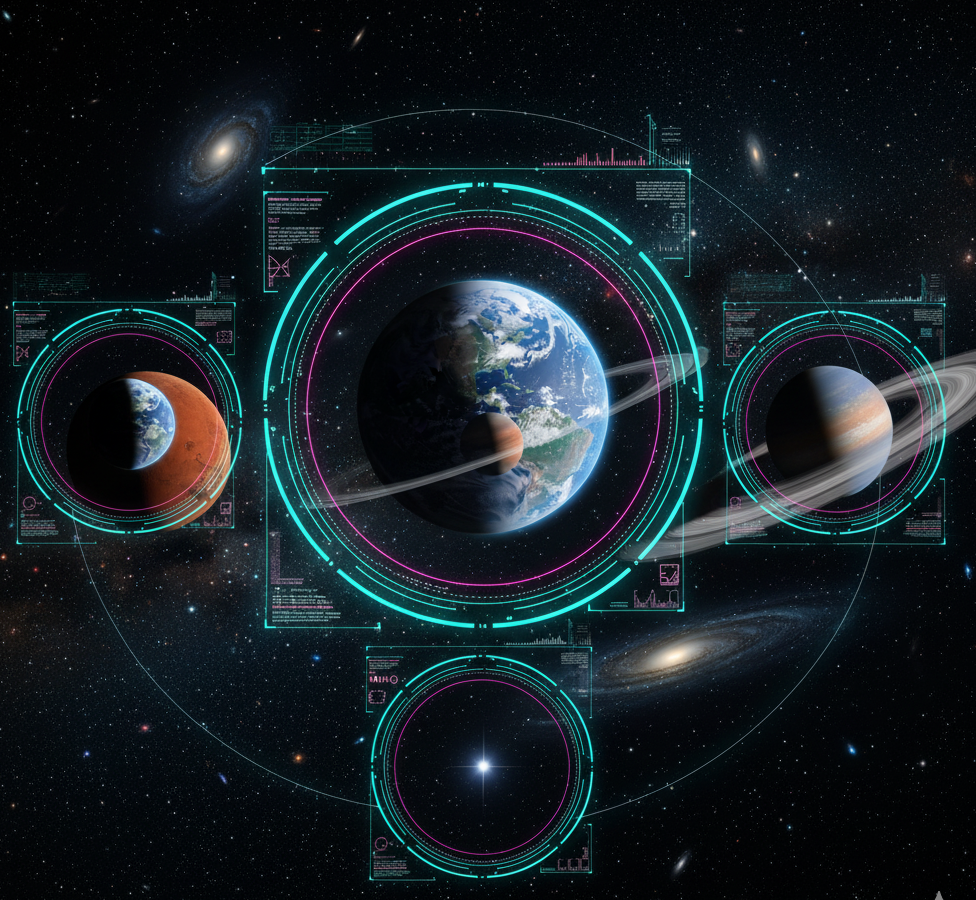
🌍 Earth from Other Planets
Visualize How Earth Appears When Viewed From Other Worlds
See Home from Alien Skies
What would Earth look like from the rust-colored deserts of Mars, or from the icy surface of Europa? Our Earth from Other Planets calculator provides scientifically accurate visualizations of how our home world appears when viewed from other locations in the solar system. From Mars, Earth appears as a brilliant blue-white “evening star” visible shortly after sunset—a pale blue dot first captured by NASA’s Mars rovers. From the outer planets like Jupiter or Saturn, Earth becomes barely distinguishable, requiring telescopes to separate it from the Sun’s glare. This perspective shift helps us understand our planet’s unique place in the cosmic order.
The calculator from SpaceTimeMesh shows Earth’s apparent magnitude, angular size, and visibility from each planet and major moon. It reveals fascinating details: from Venus, Earth never appears in a completely dark sky because Venus is closer to the Sun. From Neptune, Earth and the Sun appear as a single point of light—you’d need powerful telescopes to distinguish them. The tool uses actual orbital mechanics and photometric calculations to show brightness, phase (crescent vs. gibbous), and optimal viewing times. It demonstrates why Carl Sagan’s “Pale Blue Dot” photo from Voyager 1 remains so profound—it shows Earth’s true cosmic insignificance and preciousness simultaneously.
Perfect for astronomy educators teaching perspective and scale, science fiction writers creating realistic alien viewpoints, space mission planners considering Earth observations, or anyone wanting to appreciate our planet from an outsider’s perspective. Discover how Earth’s distinctive blue color—created by oceans and atmospheric Rayleigh scattering—makes it potentially identifiable from across the solar system, and why future exoplanet hunters look for similar “pale blue dots” around distant stars.
View Earth from Across the Solar System
🌍 Earth From Other Worlds
Experience how our home planet appears from distant cosmic vantage points
About This Tool
Scientific Data
Based on actual astronomical measurements and spacecraft observations
Visual Simulation
Simulated representation based on real brightness and angular size data
Educational
Learn about distances, brightness, and cosmic perspectives
How to Use the Earth from Planets Viewer
Step 1: Select Viewing Location
Choose which planet or major moon you want to view Earth from—options include all eight planets, plus interesting moons like Titan, Europa, and Io. Each location provides dramatically different perspectives based on distance, orbital position, and atmospheric conditions.
Step 2: View Earth’s Appearance
See Earth’s apparent magnitude (brightness), angular size (how large it appears), phase (crescent, gibbous, full), and visibility windows. The calculator shows whether Earth appears near the Sun (difficult viewing) or visible in dark skies as a distinct “evening/morning star.”
Step 3: Explore Visual Simulation
View simulated images showing Earth’s appearance in the alien sky, including Moon visibility, relative size comparisons to local moons, and how Earth’s blue color stands out. Compare different viewing dates to see how Earth’s appearance changes as planets orbit.
Earth’s Appearance from Different Worlds
🔴 From Mars
Earth appears as a brilliant blue-white “star” with magnitude -2.5 (brighter than any Mars star). The Moon is sometimes visible nearby as a separate point. Best viewed during Martian twilight. NASA’s Curiosity rover photographed this view in 2014.
🪐 From Jupiter
Earth appears as a magnitude +5 object—barely visible to the unaided eye even under dark skies. Through binoculars, you could distinguish it from the Sun. From Jupiter’s moons, Earth would be a fascinating challenge for amateur astronomers.
🌙 From the Moon
Earth appears enormous—about 4 times the Moon’s apparent size from Earth. It shows phases (full Earth, crescent Earth) and hangs nearly stationary in the lunar sky. Apollo astronauts described the “Earthrise” as the mission’s most memorable sight. Use our Earthrise calculator.
❄️ From Neptune
Earth is invisible to the naked eye at magnitude +12—requiring powerful telescopes. It appears extremely close to the Sun (maximum 17 arcsecond separation), making observation challenging. From Triton, Earth would be a faint speck requiring professional-grade equipment.
The Science of Viewing Earth
Apparent Magnitude
Earth’s brightness depends on distance and phase. From Mars, Earth reaches magnitude -2.5 (similar to Jupiter from Earth). From Saturn, it drops to +7 (binocular object). Magnitude calculations account for albedo (reflectivity), phase angle, and distance using photometric formulas developed for planetary astronomy.
Angular Separation
How far Earth appears from the Sun in alien skies depends on viewing angle. From Mars, Earth can appear up to 48° from the Sun (easily visible after sunset). From Jupiter, maximum separation is only 11°—similar to Mercury from Earth. Beyond Saturn, Earth never separates far enough to view in fully dark skies.
Blue Signature
Earth’s distinctive blue color comes from Rayleigh scattering in our nitrogen-oxygen atmosphere and liquid water oceans covering 71% of the surface. This “pale blue dot” signature is potentially detectable in exoplanet spectra, making similar blue worlds targets in the search for life beyond our solar system.
Frequently Asked Questions About Viewing Earth
Has anyone actually photographed Earth from another planet?
Yes! NASA’s Curiosity rover photographed Earth from Mars in 2014, showing Earth and the Moon as distinct points of light visible just after Martian sunset. Earlier, Mars Global Surveyor captured Earth from Mars orbit in 2003. The Voyager 1 spacecraft photographed the famous “Pale Blue Dot” image from 6 billion kilometers away in 1990. The Cassini spacecraft imaged Earth from Saturn in 2013, showing Earth as a tiny blue dot beneath Saturn’s rings—a humbling perspective of our place in the cosmos.
Could you see Earth’s continents from Mars with a telescope?
Not with current technology. From Mars, Earth’s angular size is at most 25 arcseconds—similar to how Mars appears from Earth during close approaches. Through a telescope, you could distinguish Earth as a disk showing phases, see the blue color from oceans and atmosphere, and perhaps detect the Moon as a separate object. But resolving individual continents would require telescopes far more powerful than anything currently deployed on Mars—you’d need Hubble-class optics on the Martian surface or in Mars orbit.
Why does Earth look blue from space?
Earth appears blue due to two main factors: liquid water oceans covering 71% of the surface (water absorbs red light and reflects blue), and Rayleigh scattering in the atmosphere (shorter blue wavelengths scatter more than red, similar to why our sky appears blue). The combination creates Earth’s distinctive “pale blue dot” appearance visible across the solar system. Green vegetation contributes minimally—Earth would still appear predominantly blue even without life, though oxygen in the atmosphere (a biosignature) enhances the effect.
From which planet does Earth look most impressive?
Mars provides the most impressive view—Earth appears as a brilliant blue-white “evening star” magnitude -2.5, far brighter than any star in Mars’s sky. The Moon is sometimes visible as a companion point of light. From Venus, Earth is also spectacular (magnitude -6) but only visible during daytime or twilight, never in a fully dark sky. The Moon offers the ultimate perspective—Earth appears as a large blue-white disk showing phases and weather patterns, nearly stationary in the sky. This “Earthrise” view deeply affected Apollo astronauts and remains one of humanity’s most profound experiences of cosmic perspective.
Explore More Planetary Perspective Tools
Gain new perspectives on planets and moons:
- Age on Other Planets – See your age from different planetary perspectives
- Solar System Scale Model – Understand distances between planets
- Planet Visibility Calculator – See when planets are visible from Earth
- Mars Sky Appearance – What the Martian sky looks like
- Lunar Earthrise Calculator – When Earth rises on the Moon
- Pale Blue Dot Recreator – Simulate Voyager’s famous photo
Scientific References
- NASA – Earth and Moon from Mars (Curiosity)
- NASA – Voyager 1 Pale Blue Dot
- NASA Earth Observatory – Blue Marble
- JPL – Earth from Saturn (Cassini)
- Astrophysical Journal – Earth as an Exoplanet
- Nature – Earth Viewed as an Exoplanet
- arXiv – Vegetation’s Red Edge as Biosignature
- AGU – Earth’s Pale Blue Dot Signature